
Kintsugi
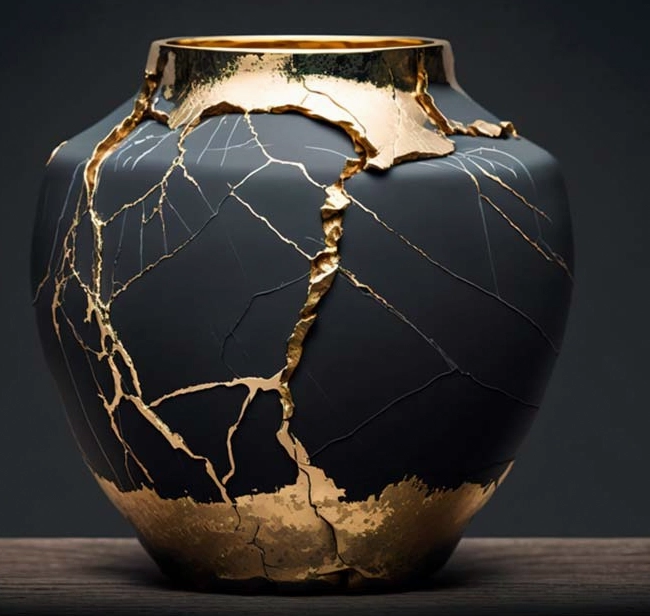
Kintsugi is the Japanese art of putting broken pottery pieces back together using gold, platinum or silver at the points of breakage — aimed with the idea that in embracing flaws and imperfections, you can create an even stronger, more beautiful piece of art.
A core point of the tradition is not only fixing the objects, but actually highlighting the imperfections, finding beauty in them.
For a long time I’ve struggled with trying and applying this idea to my own life, the struggles I endured. Doing so, feels to some extent, as a way of letting myself be defined by the pain, the scars, the harsh experiences. While I can’t and don’t want to ignore or act as if these trials and tribulations never happened, I don’t want them to define me. And yet, being restrained for so long by the consequences of these experiences, ignoring them – I find myself lost without meaning. Added to it is the ambivalence I feel about my choice of choosing a symbol, a name and branding that forever commemorates the surgeries and struggle I’ve been through.
Recently I’ve read Viktor Frankl’s “Man’s Search for Meaning” in which he suggests the best way to overcome the harshest of hardships is to find a meaning and let yourself be led by it, commit to it. The idea of Logotherapy and pushing forward through a cause and an engine you yourself decide on and define is charming and seems potent, but finding meaning, a reason to move forward, is a struggle unto itself.
Whereas usually upon starting life’s journey there’s a sense of endless possibilities available and that may lead to a sort of paralysis, once doors start to close down, life happens and the options dwindle, it’s easy to start becoming obsessed with the paths forever forsaken. You have to deal with the hand you were dealt.
I don’t agree with “whatever doesn’t kill you makes you stronger”, somethings just break you with no added benefit. I’m also not sure I can celebrate the scars and apply Kintsugi on myself – the imperfections are tied to horrible experiences whose only positive quality is probably that I survived through them, and the loud difference between “survival” and “living” was always a sore subject throughout my life.
That said – I feel I can only try to choose and accept the past, use whatever I can of it to my advantage, and focus on the present and the future.
Starting now.
This week I revive old translations from a past life, and the sketch of a song I wrote just before the surgery, when I was certain it would fail. In addition, I added a sketch catalogue to allow better navigation of the sketches and the translations.
1. Desert Divine (מים מתוקים) – A song originally written by Meir Ariel, featured on his fourth album “Seeds of Summer” (1993). A song about the complexities of love and of wanting, comparing the subject’s lover to a desert land – harsh, but pure and clean. I translated it and adjusted it several times across the last 7 or so years.
Hebrew Version (Cover) – English Version (Translation) – Side-by-Side Translation Player
2. Alexandra Leaving (אלכס שעוזבת) – A song originally written by Leonard Cohen, featured on his album “Ten New Songs” (2001). Upon coming across the song I was mind-blown by how precise it was, by the story telling, and by the fact he wrote it well into his career. It practically stayed the same ever since I translated it, back in 2017. The original version is way slower and more blues influenced, I brought it back into folk.
Hebrew Version (Translation) – English Version (Cover) – Side-by-Side Translation Player
3. The Bigger Picture – written about a month before the surgery I was pretty sure (and warned by doctors) I would not survive, or would probably come out the other side forever paraplegic, It’s probably one of my darkest songs. In my view, the seemingly unresolved Catharsis comes in the way of me surviving the ordeal and this sketch seeing the light of day.
Thanks for reading & Listening,
Yair (Screwup)